

How To Set Up A Video Wall
1. Introduction
A video-wall is a combination of two or more than screens or 'panels' which have been mounted in a rectangular arrangement. They operate together as one big canvas for displaying digital signage and video content. The figure below shows a 3×3 video-wall built from 9 panels.
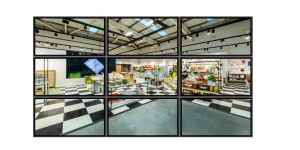
Setting-up a SignStix video-wall is relatively straightforward, providing some basic preparations are made. In brief, the fix-upward process involves:
- Preparation – this includes deciding which synchronisation method to use.
- Installation – of the panels and the SignStix devices.
- Configuration – of the SignStix devices and so that they act together every bit a wall rather than independently.
This tutorial covers a number of video-wall concepts before describing in particular the steps required to get your SignStix video-wall running successfully. Please notation:
- Information technology is assumed that you are already familiar with setting-upwards a SignStix device for a single panel. If that's not the case, delight meet http://www.signstix.com/getting-started-with-signstix/.
- Installation of the panels is not covered. Delight consult your panel supplier for guidance.
2. Video-Wall Concepts
To understand how a SignStix video-wall works, please read the following sections before attempting installation.
two.1 I SignStix Device Per Panel
In a SignStix video-wall, each panel is driven by its ain SignStix device. All the devices in the same video-wall are configured to exist in the same 'site' and 'zone'. And so when a sign is deployed to that zone, all the devices in the wall display the same sign.
However, on its own, this results in repeated content across each console, every bit in the figure beneath.
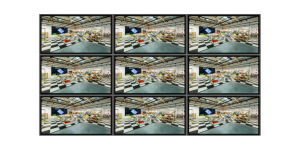 For some situations, repeating the content in this way can be constructive, only the aim here is to have 1 copy of the content spread across the entire wall.
To accomplish this, each device is configured then that information technology knows which physical region of the video-wall it represents and tin can therefore 'zoom in' on the respective function of the content, as in the first figure higher up.
2.2 Wall Resolution
The 'resolution' of a video-wall is its full width and height in terms of pixels. The greater the resolution, the more particular a wall can display, and the more impressive it will look.
For instance, suppose the resolution of a single console is 1920 x 1080. This is a mutual resolution frequently known as 'Total HD' (Loftier Definition) or '1080p'. The resolution of a 2×2 video-wall built from those panels will be double that i.e. 3840 x 2160. This resolution is known as '4K' (considering in that location are roughly iv,000 pixels along the longest side).
Nonetheless, the constructive resolution of the wall depends on the weakest link in the processing chain, not just the full number of screen pixels. The following can all have an effect:
- The resolution of the source content (video or signage).
- The maximum video resolution that a signage device tin can decode (which is 4K on current SignStix devices).
- The output resolution of a signage device (this can exist Total Hd or 4K).
- The maximum resolution that a single panel can display.
- The number of panels in the wall.
For case, if the resolution of a source video is 1920 x 1080, the effective resolution of the wall cannot exceed this considering there isn't plenty information in the video. In practice, the content will exist 'upscaled' and then that each pixel from the source video is stretched across 4 neighbouring pixels in the video-wall, as shown below.
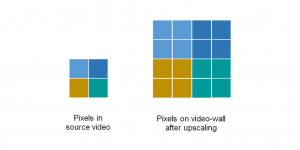
The overall effect can nevertheless be impressive in terms of physical size, merely information technology will not utilise the total adequacy of the wall. To a viewer standing close to the video-wall, it may appear slightly pixelated.
So for all-time results, the resolution of the source content should match the resolution of the video-wall
2.3 Video-Slicing
Even though the maximum resolution supported by a SignStix device is currently 4K, it is all the same possible to build a four×4 wall, say, and reach 8K resolution (assuming yous take an 8K source video to play on it).
This is because the SignStix server uses a technique called 'video-slicing' to chop a high-resolution source video into smaller 'slices'. For example, an 8K source video might exist chopped into 16 1920 x 1080 video slices, 1 for each device. (In the diagram beneath, this resolution is referred to equally '2K' to show its relationship with 8K.)
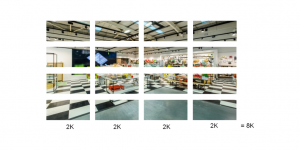
In this instance, each device will download and play its own 1920 x 1080 slice (which is well within its capabilities) instead of having to process the entire 8K source video. This also helps reduce the network bandwidth required by the video-wall.
Video-slicing works invisibly backside-the-scenes by applying video processing at the time of deploying. Note that because video processing is a complex operation, it may take some time for all the video slices to be prepared and so downloaded and displayed on the wall.
two.4 Bezel Compensation
The diagram below shows a ii×2 video-wall. The 'bezel' is the concrete frame around the flat brandish surface area. Inside the display surface area there is normally a black 'dead edge' but inside the bezel. The 'active area' is the region of pixels that can actually brandish a picture.
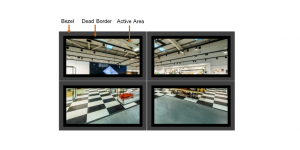 (Note that the bezels and the expressionless border have been drawn artificially broad hither to illustrate the concept.)
Ideally, the bezels and the expressionless border would have zilch width so that the panels could bring together seamlessly. Withal, in practice, there may be a few centimetres separating the active areas of neighbouring panels.
If each panel only displays its respective quarter of the content, the bezels will crusade some undesirable visual furnishings. For example, a moving object approaching a central bezel will appear to stretch and accelerate as information technology of a sudden jumps across the bezel onto the neighbouring panel.
Alignment issues will also be apparent when a bezel divides an object in two, as shown beneath. Discover how the chess-lath floor running at an angle does non appear aligned from 1 panel to the next.
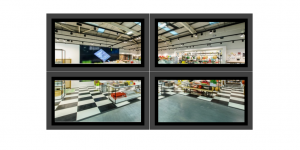
To avert these issues, 'bezel compensation' is applied. This ways discarding a pocket-size amount of graphical information (in this case, the content under the cantankerous-shape formed past the central bezels). Moving objects volition and so appear to motion smoothly 'under' the bezel from one panel to another.
With SignStix video-walls, the device configuration process handles bezel compensation automatically.
2.5 Bezel-Adapted Resolution
A knock-on effect of bezel compensation is that information technology changes the resolution of the wall slightly. For case, consider a two×2 wall built from four panels which have a resolution of 1920 x 1080. The visible resolution of the wall will be 3840 x 2160, equally discussed earlier.
However, with bezel-bounty we're finer imagining that the bezels as well contain pixels. And then to find the bezel-adjusted resolution, nosotros demand to add on the number of 'imaginary pixels' in the internal bezels. This number can exist calculated from some simple measurements, as in the figure below.
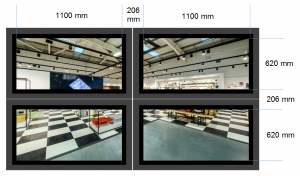
Nosotros know that the resolution of a single panel is 1920 x 1080 pixels. From the measurements above, we also know that 1920 pixels is equivalent to 1100 mm. Therefore, the number of imaginary pixels in the bezel area must be (1920 x 206) / 1100 = 360 pixels, equally shown beneath.
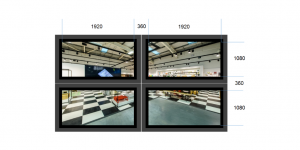
This gives a bezel-adjusted resolution every bit follows:
- Wall width in pixels = 1920 + 360 + 1920 = 4200
- Wall height in pixels = 1080 + 360 + 1080 = 2520
- Bezel-adapted resolution = 4200 x 2520
So for this example wall, signs should be created at a resolution of 4200 ten 2520 to fit the wall perfectly.
What would happen if a sign is created at the visible resolution of 3840 x 2160?
SignStix devices apply scaling as necessary to make the sign occupy the largest area possible. Nonetheless, although the sign would occupy the full width of the wall, information technology would not occupy the total peak.
This is because the ratio of width to height (the 'aspect ratio') of the two resolutions differs. The aspect ratio of the visible resolution is:
3840 / 2160 = 16 / 9
This is the familiar 16:9 ratio used in widescreen TVs. Yet, the attribute ratio of the bezel-adjusted resolution is:
4200 / 2520 = xvi / 9.half-dozen
This is a slightly 'taller' ratio, so a 16:ix sign volition not quite fit a 16:ix.6 wall. Black strips would be displayed along the pinnacle and bottom of the sign to make up the extra height available.
In conclusion, signs should be created at the bezel-adjusted resolution of the wall for the all-time fit. A formula for calculating this for any wall is provided later in this tutorial.
two.6 Panel Identification
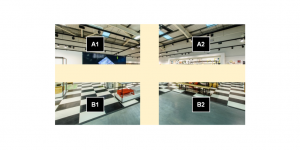
When dealing with a video-wall information technology's important to identify which panel is which, especially when it comes to configuration. For example, the top-left console needs to brandish the height-left content non the bottom-right content! The SignStix convention for this is as follows:
-
- Characterization the panel rows A, B, C and then on.
- Label the columns 1, ii, 3 and then on.
- Labelling starts from the top-left, as shown in the diagram below.
2.7 Device Synchronisation
For shine video-wall operation, it'due south manifestly vital that all the devices play 'in sync'. SignStix offers two methods to achieve this synchronisation:
-
-
- Master/Slave
- NTP (Network Time Protocol)
-
Nosotros recommend using the Master/Slave method over Ethernet (usually with all the devices directly connected to the same network switch).
With the Principal/Slave method, exactly one device (usually A1 at the height left) is nominated as the 'Master' and all the other devices in the wall are 'Slaves'. The Master sends out regular timing messages, assuasive the Slaves to synchronise their internal clocks with the Primary.
Using Ethernet minimises the delay for these timing messages and ensures the tightest synchronisation. Note that the network must support delivery of the post-obit messages:
-
-
- Multicast UDP messages on IP group 239.18.18.18, port 1234
-
Using Master/Slave over Wi-Fi is possible but not recommended due to the extra lag of wireless communication.
Alternatively, you tin can use the NTP method where all the devices synchronise against a separate time server. This can be a time server internal to your company, or an external i (see www.pool.ntp.org for more than details). The NTP method can exist used over Ethernet or Wi-Fi.
The degree of synchronisation achievable with NTP is not equally good as with Master/Slave over Ethernet, but it may exist quite acceptable for some kinds of content due east.1000. signs without a peachy deal of motion.
2.8 Coordinated Content-Switching
Specially with large content such every bit videos, the times at which the devices in a wall end downloading newly-deployed content may be spread over a menses. And so if each device starts playing new content every bit soon as it arrives, the wall will enter a transition period where some panels are showing the one-time content while others are showing new content. In general, this is not a desirable state of affairs as the wall may wait 'broken'.
So with the Master/Slave synchronisation method (where the devices are regularly communicating with each other), the chief device will try to coordinate the switchover to the new content. It volition detect when all the devices are ready, and so outcome a bespeak to switch. This causes the entire wall to switch to the new content at the same time (inside a second or two).
If the 'Download Progress Bar' setting is enabled (in 'Device Admin' in SignStix Director), a slave device which has received its new content but is still waiting (for the master to give the signal) will testify a pocket-size bluish dot at the bottom-left of the screen.
The diagnostics for the master device can also point this state. There will exist messages of the course 'New manifest waiting for <N>', where N is an identifying number of the slave device that the master is waiting for.
2.nine Portrait Walls
As well as the usual 'landscape' walls, SignStix tin can too support 'portrait' walls where each screen is mounted in a portrait orientation. However, in that location are some limitations. Please see the 'How-To' on portrait screens for more data.
3. Grooming
At the planning stage for a video-wall, your preparations should include the following:
Decide on the video-wall specifications including:
-
-
- Position
- Panel model (consider resolution, brightness, bezel width, reflectiveness
- Number of rows and columns of panel
- Panel mounting
- Power cabling
- Network cabling
-
Decide where yous will position the SignStix devices. Run across http://www.signstix.com/preparing-a-signage-device/ for requirements regarding air-menstruum and estrus.
Make up one's mind which device synchronisation method you will utilize:
-
-
- If using Master/Slave over Ethernet, ensure the network supports the timing messages described before.
- If using NTP, decide which fourth dimension server you lot will employ and ensure it will not be blocked by your firewall.
-
iv. Configuring the Video-Wall
At this stage it is assumed that:
-
-
- The SignStix devices accept been installed and powered upwards.
- The SignStix devices have been connected to your network and to their corresponding panels (which are besides switched on).
- The devices have been registered to your SignStix business relationship.
- The devices are at present displaying a default sign on the panels.
- The SignStix devices accept been installed and powered upwards.
-
If any of the higher up are not truthful, please see the guidance on setting up individual devices at http://www.signstix.com/getting-started-with-signstix/.
four.1 Set the Location
All devices in the wall should be ready to the same location. When in master/slave fashion, this allows the devices to know that they belong to the aforementioned wall and should listen to each other's synchronisation messages. Having the devices in the same location likewise makes it easier to assign content to the video wall i.eastward. assign it to the location and all the devices will adopt that content.
Once all the devices are in the same location, assign a test sign to the location, click 'Deploy, and bank check that (after a short delay upwards to 1 minute), all the panels are showing the exam sign.
4.2 Set the Wall Geometry
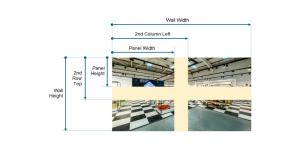
The next step is to tell each SignStix device which part of the wall it represents. For a 2×2 video-wall you will need to make but six concrete measurements, as shown in the figure below.
-
-
- Always measure to the edge of an active area, not the border of a console.
- Outset measuring from the top-left of the active surface area within the meridian-left console.
-
It is recommended that all measurements are taken in millimetres.
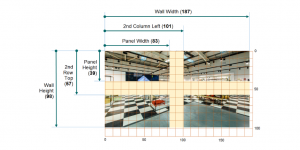
The figure below shows some example measurements (with a super-imposed grid starting at the top-left).
After you take fabricated your measurements:
-
-
- Navigate to 'Devices' in SignStix Director.
- For each device in the video-wall, click the pencil icon to open up the settings for that device.
- In the 'Video Wall' department, set the 'Console Width', 'Panel Tiptop', 'Wall Width' and 'Wall Top' to the measurements you fabricated in a higher place. They will be the aforementioned for each device.
-
The only settings that vary per-device are the 'Panel Left' and 'Panel Superlative'. These determine where the top-left betoken of each panel is within the wall. Gear up them as follows, replacing the terms in square brackets with your bodily measurements in a higher place.
Device A1 (acme-left)
Panel Left:0
Panel Top:0
Device A2 (acme-right)
Panel Left:[second Column Left]
Panel Top:0
Device B1 (bottom-left)
Panel Left:0
Panel Acme:[second Row Height]
Device B2 (bottom-correct)
Panel Left:[2nd Cavalcade Left]
Panel Top:[second Row Top]
For larger walls you will need to make one farther 'Top' measurement for each boosted row and one further 'Left' measurement for each boosted column.
Having set the geometry for all the devices, bank check that the deployed sign at present extends over all the panels, and that objects which extend over multiple panels appear properly aligned.
Don't be alarmed if narrow blackness strips are displayed at the superlative and bottom of the wall. This may just reflect an aspect ratio difference between the deployed sign and the wall, as described earlier.
4.3 Gear up the Synchronisation Method
At this phase, each panel should be showing the correct part of a sign. However, if the sign includes animation, information technology may exist apparent that the panels are 'out-of-sync' i.eastward. move in one panel does non match upward with movement in some other. This is because the devices demand their synchronisation method configuring, as follows:
-
-
- Navigate to 'Devices' in SignStix Director.
- For each device in the video-wall, click the pencil icon to edit the settings for that device.
- Set up your called 'Synchronisation Method'.
a.If yous're using Master/Slave, set this to 'Internet Master' for the meridian-left device (A1) only, and prepare it to 'Net Slave' for all the others in the wall.
b.If y'all're using NTP, set this to 'NTP' for all the devices in the wall, and also set the 'NTP Server' to be the IP address or proper noun of your time server.
-
In one case all the devices have had their synchronisation method set, deploy a sign with some animation and ensure that (after a minute or two) all the panels announced to be 'in-sync'.
4.4 Set the Signage Sheet Size
To make the best utilise of your video-wall, you should blueprint content at the same resolution as the wall. Summate the bezel-adjusted wall resolution every bit follows, where C, D, East and F are measurements you lot have already fabricated:
C = Wall Width in mm
D = Wall Height in mm
E = Panel Width in mm (of active area)
F = Panel Pinnacle in mm (of agile area)
P = Console Width in pixels e.g. 1920
Q = Panel Height in pixels e.g. 1080
S = Wall Width in pixels = (P ten C) / E
T = Wall Acme in pixels = (Q x D) / F
Wall Resolution in pixels = S ten T
You should now add this resolution as a SignStix 'preset' so that you lot can easily create signs with the correct dimensions:
1. Launch SignStix Creator
2. Choose 'New Sign'
3. In the 'Preset' menu cull 'New Custom Preset'
four. Enter your Southward and T values in the 'Width' and 'Height' fields.
5. Click 'Save Preset As' and enter a convenient name eastward.g. 'ii×two Video Wall'
6. Your preset will now exist bachelor in the 'Preset' menu next fourth dimension you create a sign
5. Terminal Checks
Your SignStix video-wall is now fully configured! Y'all should be able to deploy content to the wall and see:
-
-
- The content spread correctly over the full extent of the wall.
- All the devices/panels playing in-sync.
-
If this is not the example, please see My video-wall isn't working properly.
Source: https://signstix.com/support/tutorials/setting-up-a-video-wall/
0 Response to "How To Set Up A Video Wall"
Post a Comment